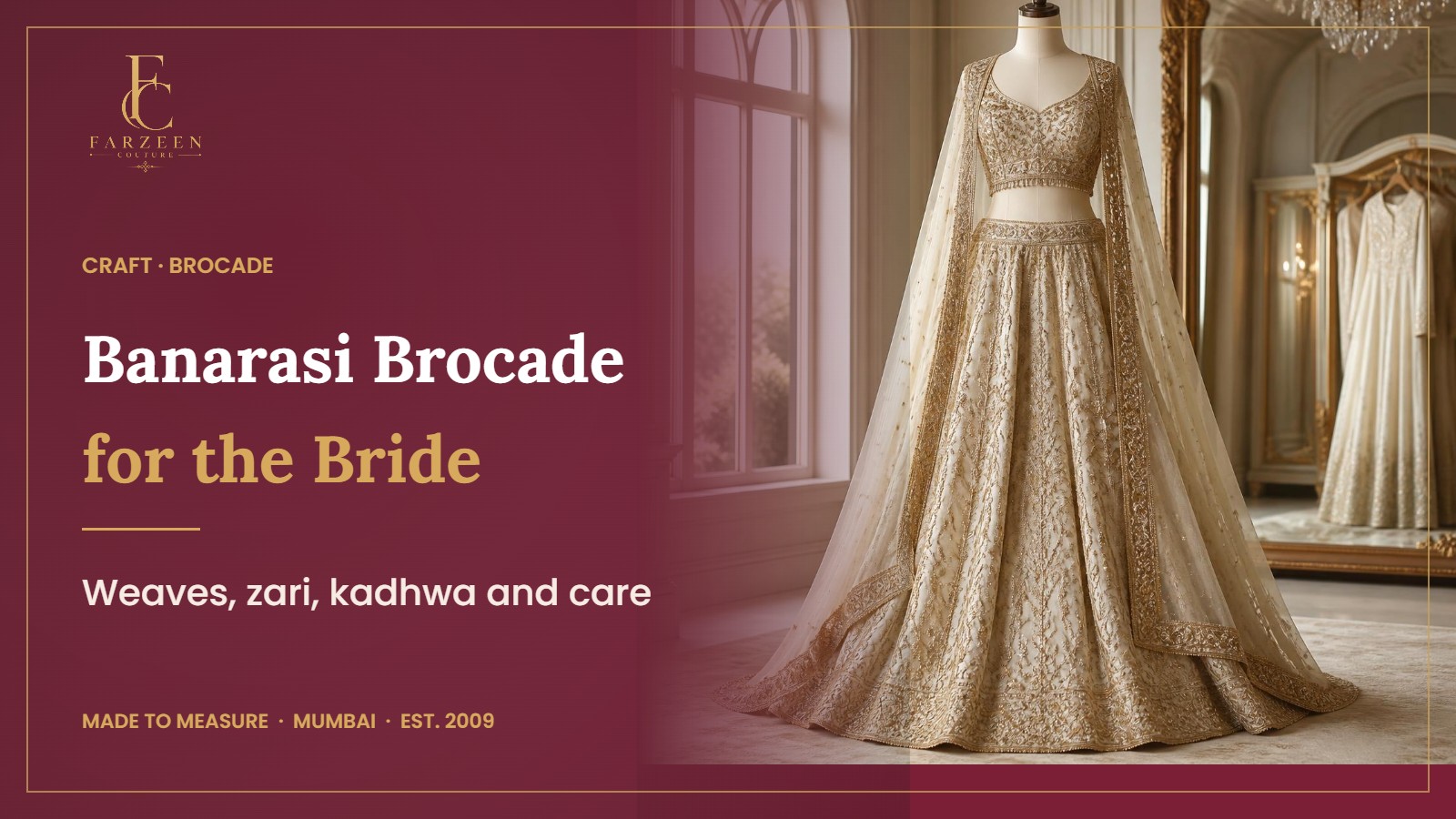
Banarasi Brocade: A Guide for Bridal Couture
Craft
By Farzeen Lala · Published
You find a bridal lehenga you love, and the label says "Banarasi brocade". It looks rich and regal, but you are not sure what that word really means, how it differs from embroidery, or whether it will feel too heavy on your wedding day. Many brides face the same question, because brocade is one of the most admired fabrics in Indian bridal wear and one of the least explained.
This guide explains what brocade is, how Banarasi brocade is woven, the main weave styles you will hear about, and how to use it well in a made-to-measure bridal outfit. If you want a wider comparison of silk, velvet, net and other bases first, read our bridal lehenga fabric guide.
What Is Brocade Fabric?
Brocade is a woven fabric in which the pattern is made on the loom, not added afterwards. While the cloth is being woven, the weaver inserts extra pattern threads, often silk or metallic zari, into the base warp and weft. These extra threads build the motif, so the design sits slightly raised on the surface and looks almost embroidered, even though no needle has touched it.
That is the key difference between brocade and embroidery:
Brocade: the pattern is part of the fabric itself. It is created thread by thread as the cloth grows on the loom.
Embroidery: the fabric is woven plain first, then the pattern is stitched on top by hand or machine.
Because the design is already in the weave, a brocade outfit can look grand with very little surface work.
What Makes Banarasi Brocade Special
Banarasi brocade comes from Varanasi (Banaras) in Uttar Pradesh, one of India's oldest weaving centres. It is usually woven in silk and often decorated with zari, a metallic thread made by wrapping a fine metal strip around a silk or cotton core. Its motifs show a long blend of Indian and Persian design ideas: flowering creepers, paisleys, trees of life, lattice patterns and small scattered flowers.
In 2009, "Banaras Brocades and Sarees" received a Geographical Indication (GI) tag. This means the name is linked to a defined weaving region around Varanasi, in the same way that some foods and crafts are protected by where they are made.
How Banarasi Brocade Is Woven
Weaving a Banarasi brocade is slow, skilled work shared by several craftspeople. In simple terms, it follows these steps:
The design plan: a design specialist, called a naqshaband, turns the motif into a technical plan, known as the naqsha, that tells the loom which threads to lift for each line of the pattern.
Preparing the yarn: silk is cleaned, dyed and wound, and the warp threads are set up on the loom.
Setting the loom: on traditional handlooms, the pattern is set with a jala or a jacquard attachment, which lifts the right warp threads in order.
Weaving: the weaver passes the base weft across the loom and, line by line, adds the extra silk or zari threads that form the motifs.
Finishing: the woven cloth is checked, trimmed where needed and finished to bring out its sheen.
Depending on how detailed the design is, a single handwoven Banarasi piece can take anywhere from a couple of weeks to several months on the loom.
Kadhwa and Cutwork: Two Ways to Weave the Motif
When you look closely at Banarasi brocade, you will often hear two words: kadhwa and cutwork. They describe how the pattern threads are placed.
Kadhwa: each motif is woven separately, and the extra thread stays only inside that motif. Nothing floats across the back, so the reverse looks neat. It is slower and more skilled, and the motifs are firmly locked into the cloth.
Cutwork: the extra thread runs across the whole width of the fabric. After weaving, the loose threads between motifs are trimmed away by hand. It is quicker and lighter, and you will see small clipped thread ends on the back.
Both can be beautiful. The simplest check is to turn the fabric over and look at the back.
Types of Banarasi Weaves You Will Hear About
Banarasi brocade is a family of weaves, not one single fabric. These are the names brides come across most often:
Kimkhab (kinkhab): the richest style, worked densely in gold and silver zari so that the metal covers much of the surface.
Jangla: an all-over pattern of trailing vines and flowers, named after the Hindi word for forest. It is one of the oldest Banaras layouts.
Butidar: small motifs, called butis, scattered across the ground. It gives a lighter, more spaced look.
Tanchoi: a satin-like silk with a close, all-over pattern woven in coloured silk threads, often with little or no zari.
Amru: brocade woven only in silk threads, so the pattern shows silk on silk, without metal.
Tissue: a fine, light fabric woven with metallic threads that give it a soft, glowing shimmer. It is often used for dupattas.
For a bride, the practical question is simple: do you want gold to dominate, or do you want colour and pattern with a quieter shine? Kimkhab and dense jangla read as grand and traditional. Tanchoi, amru and butidar feel softer and work well for brides who prefer less metal.
How Brocade Is Used in Bridal Couture
Brocade has body and structure, so it holds shape well. In a made-to-measure outfit, it can be used in several ways:
The full lehenga skirt: a brocade skirt has a natural flare and a rich surface. It suits brides who want a heritage look and prefer less embroidery.
The blouse: a brocade blouse paired with a net or organza skirt balances weight and adds richness close to the face. See our guide to lehenga blouse back designs for shapes that suit a structured fabric.
Borders and panels: brocade borders on the hem, or panels set into the kalis of the skirt, bring the woven pattern into a lighter outfit.
The dupatta: a brocade or tissue dupatta adds grandeur to a simpler lehenga.
Men's couture: brocade is also a classic choice for sherwanis and jackets, which our groom sherwani guide covers in more detail.
Brocade with Hand Embroidery
Brocade does not have to stand alone. Fine hand embroidery, such as zardozi, dabka, pearls or sequins, can be added along the woven motifs to give them more depth, or used on a separate layer. Because brocade is already patterned and fairly firm, the embroidery should follow the weave rather than compete with it. Our short guide to zardozi, dabka and beadwork explains how each type of handwork looks and feels.
Choosing Brocade for Your Wedding: A Checklist
Before you decide on a brocade outfit, go through these points with your designer:
Season: brocade feels warm and substantial, so it is a natural fit for cool evenings and winter functions. For a daytime summer function, consider using it only in the blouse, border or dupatta.
Weight: ask to hold a sample. Dense zari brocade plus a full skirt plus embroidery can become heavy over many hours.
Metal or silk: decide whether you want a gold-led look or a silk-led one, and ask what kind of metallic thread is used.
Handloom or powerloom: both exist. Ask which one your fabric is, and look at the back for the signs of kadhwa or cutwork.
Pattern scale: large motifs make a bold statement on a full skirt. Smaller butis suit petite frames and blouses.
Colour: zari reads differently on deep reds and maroons than on pastels or ivory. See the fabric in natural light and in warm indoor light.
Function: a brocade lehenga suits the main ceremony or reception. For the sangeet or mehendi, lighter fabrics usually work better.
If your wedding is in the cooler months, our guide to winter wedding outfits has more ideas for the whole family.
Caring for a Brocade Outfit
A brocade lehenga can be kept for many years with a little care:
Use professional dry cleaning only, and choose a cleaner who handles zari and silk.
Store it in a soft muslin or cotton cloth, never in plastic, so the fabric can breathe.
Avoid sharp folds. Refold it along different lines every few months so the zari does not crack.
Frequently Asked Questions
What is Banarasi brocade and how is it different from embroidery?
Banarasi brocade is a silk fabric from Varanasi in which the pattern, often in gold or silver zari, is woven into the cloth on the loom, while embroidery is stitched on top of a fabric after it has been woven. That is why brocade looks rich even with little or no surface handwork.
Is a Banarasi brocade lehenga good for a winter wedding?
Yes, a brocade lehenga is a very good choice for a winter wedding, because the fabric is dense, warm and holds its shape. For warmer days, you can keep the brocade to the blouse, border or dupatta and use a lighter fabric for the skirt.
How can I tell if brocade is handwoven?
Turn the fabric over and look at the back: handwoven brocade often shows small irregularities, and in kadhwa weaving the back is neat, with no cut threads between motifs. Powerloom fabric tends to look perfectly even. If unsure, ask your designer how it was woven.
Can I order a Banarasi brocade bridal lehenga from Mumbai for a wedding in the USA or UK?
Yes, you can order a made-to-measure brocade bridal lehenga from a Mumbai atelier for a wedding abroad, using a video consultation, measurements taken at home and international shipping. Our worldwide orders page explains how this works, and timelines are confirmed at your consultation.
Is a brocade lehenga very heavy to wear?
It depends on the weave and the design: a dense kimkhab skirt with added embroidery can feel heavy, while a butidar or tanchoi brocade feels much lighter. Pairing a brocade blouse or border with a net or organza skirt is a good way to get the look without the weight.
Have It Made for You
Brocade carries centuries of weaving skill, and it deserves an outfit cut and finished around you. At Farzeen Couture, every piece is made to order and hand-finished to your measurements in our Mumbai atelier, and we can talk through whether brocade suits your wedding, your season and your style. You can see how each outfit takes shape on our craft page.
When you are ready, start your design with Custom Made Now, book a consultation, or message us on WhatsApp.