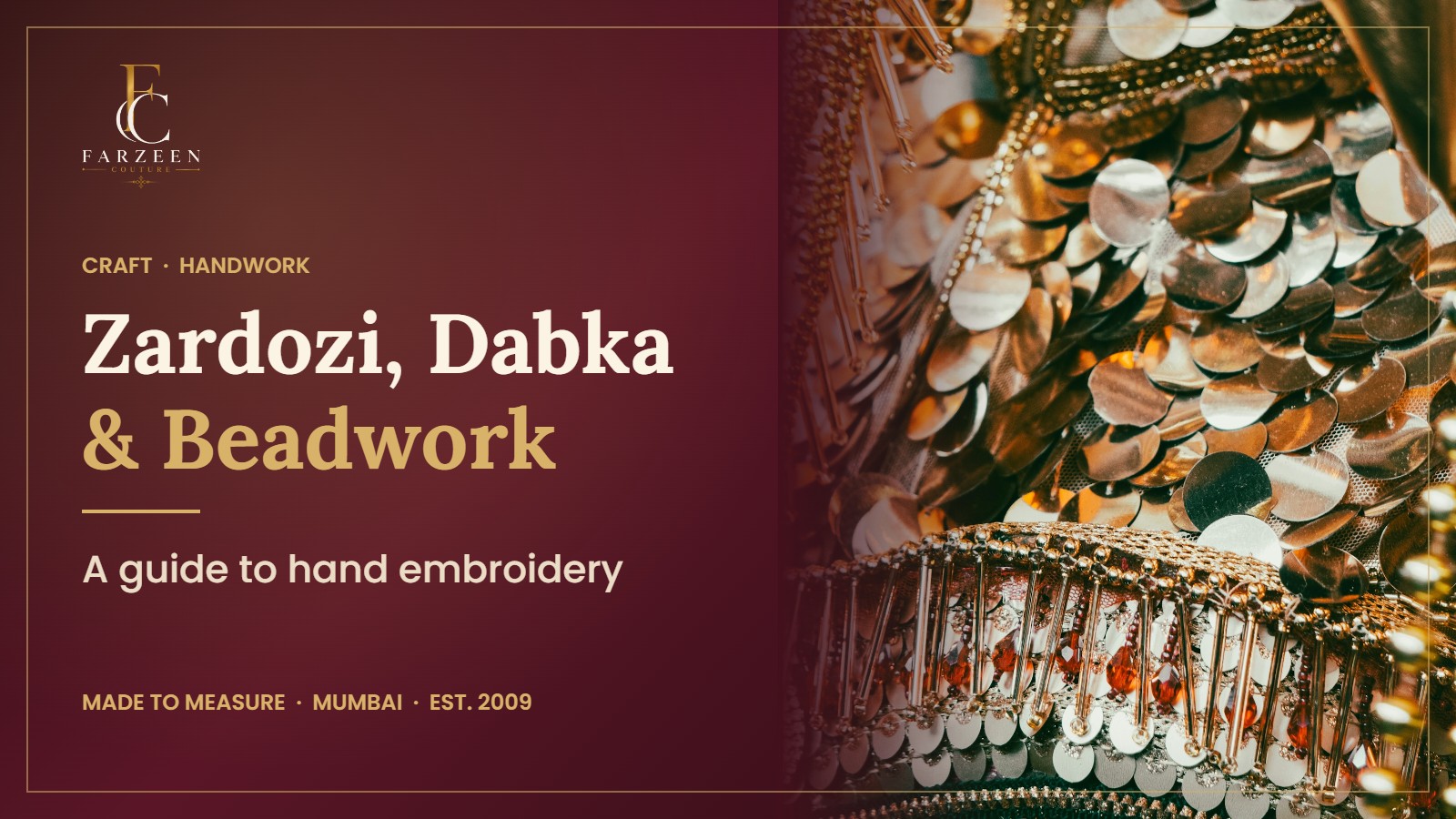
Zardozi, Dabka and Beadwork: A Short Guide to Hand Embroidery
Craft
By Farzeen Lala · Published
You find a lehenga you love, and the description says "zardozi with dabka and pearl detailing". It sounds beautiful, but what does it actually mean, and how is it different from the sequins on a ready outfit at the mall? When you are choosing a couture piece, knowing the names of the techniques helps you ask for exactly what you want.
This short guide explains the main forms of hand embroidery used in Indian bridal and couture wear, what each one looks like, where it works best, and how to decide how much handwork your outfit needs.
Why Hand Embroidery Matters in Couture
Handwork is a big part of what makes an outfit couture. Machine embroidery repeats the same motif in the same way across a whole length of fabric. Hand embroidery is placed stitch by stitch, so the artisan can follow the shape of your blouse, the flare of your skirt and the line of your neckline.
Hand embroidery also has texture. Raised metallic work, layered beads and scattered crystals catch the light differently as you move, which is why heavily worked outfits look so rich in person and in photographs. Each piece is a little different, because no two hands work in exactly the same way.
You can see how the atelier approaches this work on our Our Craft page.
Zardozi: Raised Metallic Embroidery
The word zardozi comes from Persian, where "zar" means gold and "dozi" means embroidery. The craft has a long history in India and flourished in the Mughal courts, where it decorated royal clothing, tents and furnishings.
Today, zardozi is metallic embroidery done by hand with gold- or silver-toned thread, wire and small metallic elements. It is often raised, built up over padding so the motifs stand slightly above the fabric. That raised quality is what makes it catch the light so well on velvet and silk.
Where zardozi works best
Bridal lehengas: borders, kalis and all-over motifs on the skirt.
Blouses: necklines, sleeves and back panels, where people see the detail up close.
Sherwanis: collars, cuffs and front plackets. Our groom sherwani guide explains how much embroidery suits a groom's look.
Velvet pieces: the deep pile of velvet makes metallic work stand out strongly.
Dabka: Fine Coiled Detail
Dabka uses a fine, tightly coiled metallic wire. Short lengths are cut, threaded and stitched down onto the fabric, so the coil sits in a neat line or curl. It is often used together with zardozi rather than on its own.
We use dabka for delicate outlines, borders and fine lines of detail. Because it is slim and precise, it defines a motif clearly without adding as much bulk as heavy raised work. It is a good choice when you want a refined, crisp finish.
Dabka in practice
Outlining motifs: giving flowers, paisleys and vines a clean edge.
Borders: creating fine, continuous lines along a dupatta or hem.
Filling small areas: adding texture inside a motif without making it too heavy.
Beading, Pearls and Crystals
Beads, pearls and crystals are sewn on one at a time. Each one changes the surface of the fabric in its own way, and together they give an outfit a depth that printing or machine embroidery cannot match.
Bugle beads: long, tube-shaped beads that give a linear, shimmering texture. They work well in geometric patterns and for evening wear.
Seed beads: tiny round beads used to fill areas or trace fine lines.
Pearls: soft and luminous. They suit ivory, blush and pastel outfits and add a gentle, classic finish.
Crystals: add sparkle that shows up beautifully under evening lights at a sangeet or reception.
Sequins: small reflective discs that add movement and shine when placed by hand among other work.
Many couture outfits combine these with zardozi and dabka. A motif might be outlined in dabka, filled with zardozi and finished with a scatter of pearls or crystals. For guidance on pairing embellishment with colour and silhouette, see our guide to choosing your bridal lehenga.
Why Handwork Takes Time
Hand embroidery is slow, careful work. Each motif is drawn, placed and stitched by hand, usually with the fabric stretched on a frame, before the panels are cut and put together. Here is how it typically comes together:
Design: the embroidery layout is sketched and agreed with you.
Tracing: the pattern is transferred onto the fabric panels.
Framing: each panel is stretched on a wooden frame so it stays flat and even.
Embroidery: artisans stitch the zardozi, dabka, beads and other details by hand.
Checking: the finished panels are checked for evenness and secure stitching.
Construction: the panels are cut and stitched together into the final outfit, then finished and fitted.
How much handwork you choose changes both the look of the outfit and how long it takes. All-over embroidery needs much more time than a worked border. To see the whole process from sketch to delivery, read how a couture outfit is made.
How to Choose the Right Amount of Handwork
There is no single right answer. The best level of embroidery depends on the occasion, the fabric and how you want to feel wearing it. A few things to think about:
Weight: heavy metallic work and dense beading add weight. If you plan to dance or wear the outfit for many hours, balance a rich blouse with a lighter skirt or dupatta.
Focus: decide where you want attention to fall, such as the blouse, the border or the dupatta, and concentrate the work there.
Fabric: sturdy fabrics like velvet and raw silk hold heavy work well. Sheer net and organza suit lighter, scattered embellishment.
Lighting: crystals and sequins shine under evening lights, while matte zardozi and pearls look beautiful in daylight.
Wearing it again: lighter, focused embroidery is easier to restyle for other events later.
Bring a photograph of the embroidery you like to your consultation, and we will help you decide where it counts most.
Caring for Hand-Embroidered Couture
Hand embroidery lasts for years when it is looked after well. A few simple habits help keep metallic work, beads and crystals in good condition:
Store it flat or loosely folded with soft muslin or acid-free tissue between layers, so the embroidery does not press against itself.
Keep it away from damp and direct sunlight, which can dull metallic thread and fade fabric.
Avoid spraying perfume directly onto embroidered areas.
Choose professional dry cleaning from a cleaner experienced with embellished garments.
Air it out now and then so the fabric can breathe between wears.
Frequently Asked Questions
What is the difference between zardozi and dabka?
Zardozi is raised metallic embroidery built up with gold- or silver-toned thread and wire. Dabka uses a fine coiled metallic wire stitched down in lines and curls. Dabka is often used to outline or add fine detail within zardozi work.
Is hand embroidery heavier than machine embroidery?
It can be, especially with dense metallic work and beading. The weight depends on how much of the outfit is covered and which materials are used, so it can be balanced with lighter fabric in other parts of the outfit.
Can I choose where the embroidery goes on my outfit?
Yes. In a made-to-measure outfit, the placement and amount of embroidery are decided with you during the design stage, before any work begins.
Why does handwork take longer?
Every motif is traced, framed and stitched by hand, often one panel at a time, before the outfit is assembled. More embroidery means more hours of careful work, so it helps to plan early.
Do pearls and crystals suit every outfit?
They suit most outfits, but the effect differs. Pearls give a soft, classic finish that works well on pale shades, while crystals add sparkle for evening events. Your designer can suggest what fits your colour and occasion.
Have It Made for You
Every embellished outfit at Farzeen Couture is designed with you and embroidered by hand in our Mumbai atelier, then cut to your own measurements. Explore our bridal couture for inspiration, then share a photo of the work you love through Custom Made Now or message us on WhatsApp. You can also book a consultation in person or by video call.