From Inspiration to Final Outfit: How Your Couture Is Made
Process
By Farzeen Lala · Published
You have saved dozens of photographs, you know the colour you love, and you have a date in the diary. But the step from "I like this" to an outfit made just for you can feel like a mystery. Who decides the design, how is the fabric chosen, and what actually happens between the first conversation and the final fitting?
A couture outfit starts well before the first stitch. It starts with an occasion, a colour or a photograph you keep going back to. This guide walks you through each stage of how that idea becomes an outfit made for one person, so you know what to expect and how to prepare.
What Makes an Outfit Couture
Couture means the outfit is designed and made for one person. Nothing is taken off a rail and altered. At Farzeen Couture, every piece is made to order:
Designed with you: the colour, embroidery, sleeves, neckline and silhouette are decided together.
Cut to your measurements: not a standard size, so the outfit is shaped to your body from the start.
Finished by hand: embroidery and embellishment are done by artisans, one panel at a time.
The process follows the same journey for every order: inspiration, consultation, design and sketch, fabric and handwork, fitting and finishing, and delivery.
Stage 1: Start with Your Inspiration
Bring whatever you have. It might be a photograph, a sketch, a fabric you like, a look from our bridal collection, or just a memory of a colour. You do not need a finished design. Working that out is our job.
We will ask about the occasion, the silhouette you like, how much handwork you want and your budget. Everything after that is built around your answers.
How to gather useful inspiration
Save photographs of details you love, such as a neckline, a sleeve or a border, not only full outfits
Note what you do not like, which is just as helpful
Think about where and when you will wear the outfit, and for how long
Collect colours you want to match, such as a partner's or a family member's outfit
Stage 2: Consultation and Design
You can visit the atelier in Mumbai or talk to us on a video call. Either way, it is a conversation. We look at your inspiration together and tell you what will suit you and what will not.
Then we sketch the outfit, including the front, the back, the neckline, the sleeves and where the embroidery will sit. We change the sketch with you until it feels right. We do not move on until you approve the design, and production begins only after that approval.
This is also the moment to talk about every piece of the look. If you are planning a bridal lehenga, our guide to choosing the colour, embroidery and silhouette helps you think through each decision before the consultation.
Questions worth asking at your consultation
Which silhouette suits my height and the way I plan to move on the day?
Where should the embroidery sit so it shows best in photographs?
Will this fabric be comfortable for the length of the function?
How heavy will the finished outfit feel, including the dupatta or veil?
Which parts of the design matter most if we need to balance the budget?
When do you need my measurements, and how will we confirm the fit?
There are no wrong questions. The more you share, the closer the sketch will be to what you have in mind.
Stage 3: Fabric and Colour
We choose fabric for how it drapes and how well it holds embroidery. A fabric that looks beautiful on its own may not carry heavy handwork, so this choice shapes everything that follows.
Drape: softer fabrics flow and move, while firmer ones hold structure.
Weight: heavier embroidery needs a base fabric strong enough to support it.
Season and comfort: the date and venue matter, especially for long ceremonies.
Colour: if the exact shade matters, we have the fabric dyed to match.
Stage 4: Handwork, Panel by Panel
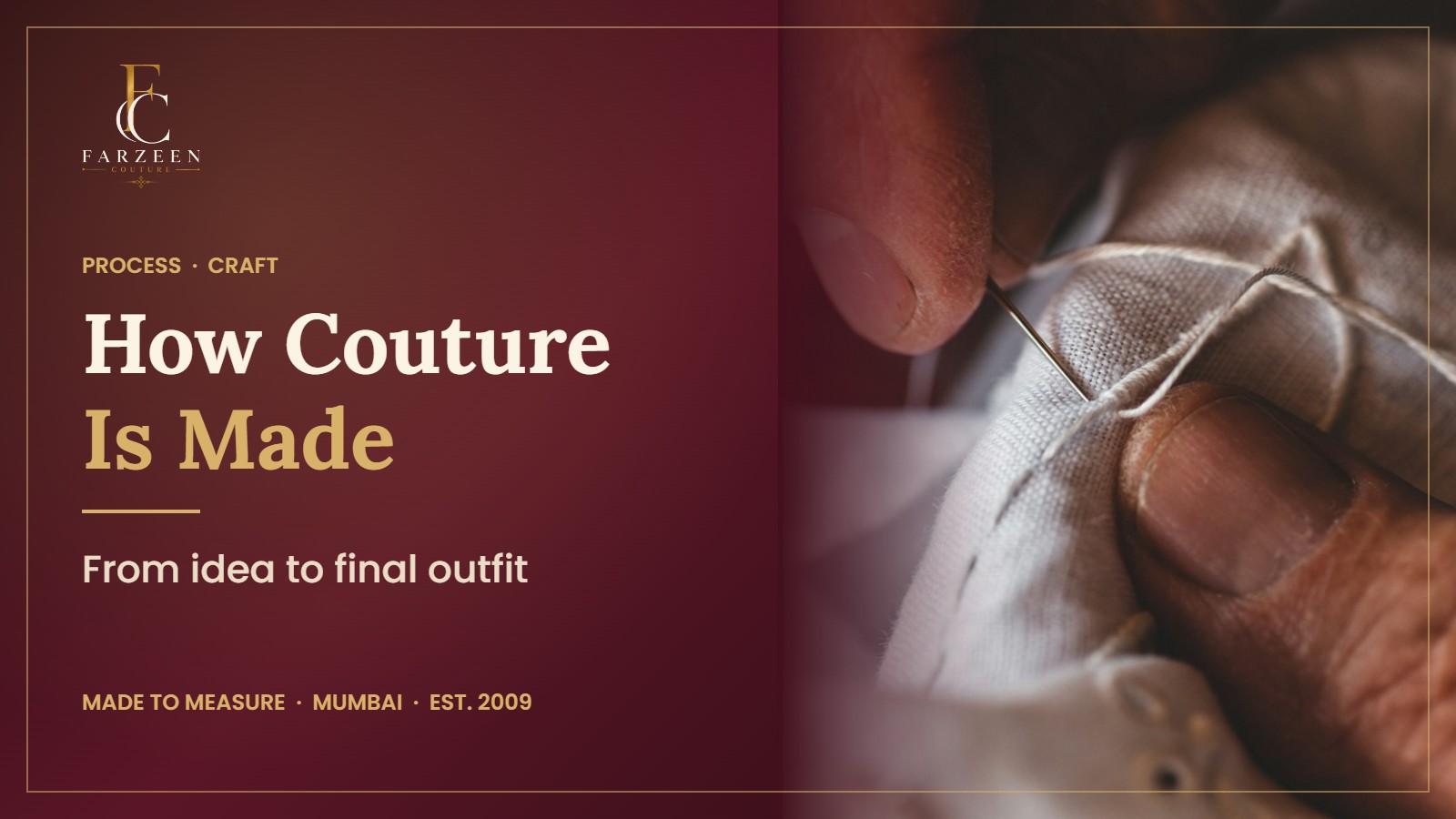
Once the design and fabric are set, our artisans embroider and embellish the outfit by hand, one panel at a time. Zardozi, dabka, beadwork, pearls and crystals each add their own texture. Read our short guide to zardozi, dabka and beadwork to see how each technique looks and feels.
Beads, pearls and crystals are placed one by one, so no two outfits come out the same. It also means handwork takes as long as it takes. The more of the outfit the embroidery covers, the more time it needs, which is why early planning matters. You can see more of this work on our Our Craft page.
We send progress updates on WhatsApp along the way, so you can watch your outfit take shape. If something in a photograph does not look the way you imagined, say so early. Small questions raised during the handwork stage are far easier to answer than changes requested once the panels have been finished and assembled.
Stage 5: Fitting, Finishing and Delivery
Your outfit is cut to your measurements, not a standard size. We fit it, adjust it and finish it by hand. During a fitting, it helps to move the way you will on the day:
Sit down and check that nothing pulls or pinches.
Raise your arms as if to greet someone or dance.
Walk and turn in the shoes you plan to wear.
Check the weight of the dupatta, veil or stole over a few minutes.
Look at the details in daylight, such as the hem, the closures and the finishing.
When everything is right, we pack the outfit carefully and deliver it, in Mumbai or anywhere in the world. If you live overseas, read ordering couture from abroad to see how video consultations, measurements and shipping work.
Your Couture Planning Checklist
Because every outfit is made to order, the timeline depends on your design and the amount of handwork. We confirm your timeline with your quote, before you place the order. Use this checklist to stay ahead:
Fix your dates and list every function you need an outfit for.
Gather inspiration photographs and colours.
Book a consultation in person or by video call.
Agree on the design, fabric and budget, and approve the sketch.
Share your measurements or attend your measuring session.
Follow the progress photos and reply to questions quickly.
Attend your fitting and test the outfit with real movement.
Receive your outfit with time to spare before the first function.
Frequently Asked Questions
Do I need a finished design before I contact you?
No. A photograph, a colour or an idea is enough. We work out the design with you during the consultation and sketch it until it feels right.
When does work on my outfit begin?
Production begins only after you approve the design. Before that, you can ask for changes to the sketch, the fabric and the colours.
Can the fabric be made in a specific colour?
Yes. If the exact shade matters to you, the fabric can be dyed to match.
Will I know how my outfit is progressing?
Yes. We send progress updates and photographs of the handwork on WhatsApp, so you can watch your outfit take shape.
How long does a couture outfit take to make?
It depends on the design and the amount of handwork. The atelier confirms your timeline with your quote, so contact us as early as you can, especially for a wedding.
Have It Made for You
Every outfit we make starts with one idea and ends with a piece made for one person. Share your inspiration and your date through Custom Made Now or message us on WhatsApp, and we will take you through each stage. You can also book a consultation at the atelier in Mumbai or by video call.